Network Overview
Primus Network is a decentralized verifiable confidential-computing infrastructure that combines authenticated Web2 data attestation with privacy-preserving computation. It enables applications and agents to execute verifiable tasks through zkTLS and privacy-preserving computation, allowing off-chain actions to be validated with stronger trust guarantees.
Network participants
Node operators (Attestors)
Node operators run attestor infrastructure to execute network tasks and return verifiable outputs. They are responsible for service availability, protocol-compliant execution, and stable task handling.
Developers
Developers integrate the Primus SDK into applications and define task logic, data requirements, and verification conditions for their products.
Clients
Clients (end users or applications acting on their behalf) submit tasks through integrated apps and consume the resulting verified outputs.
Architecture overview
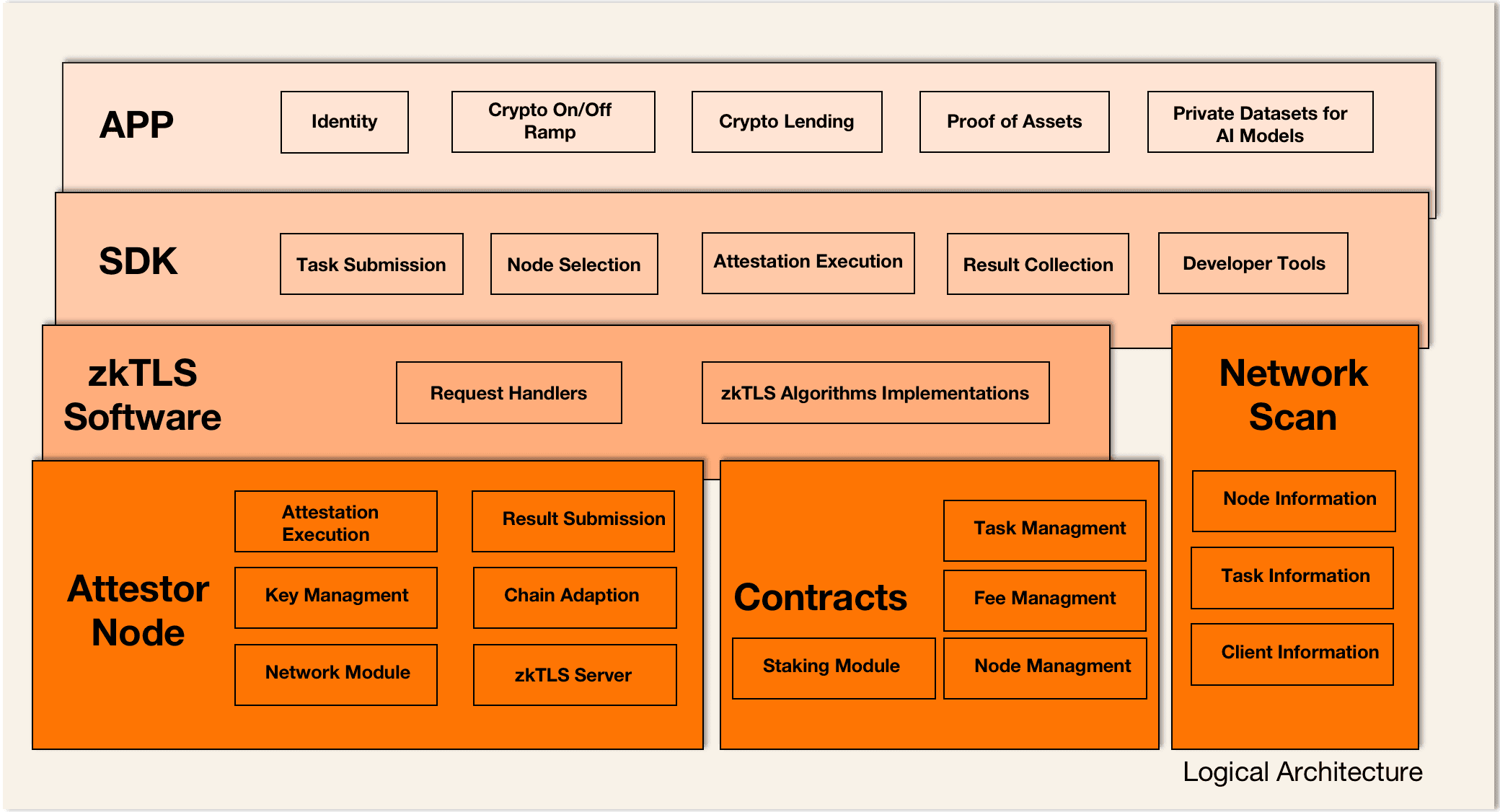
The Primus Network combines three core layers:
- Protocol contracts: Coordinate task lifecycle, settlement, and network-level state.
- Node operator layer: Executes assigned tasks and produces attestations/results.
- Primus SDK: Connects applications to network workflows, including task submission and result consumption.
Task workflow
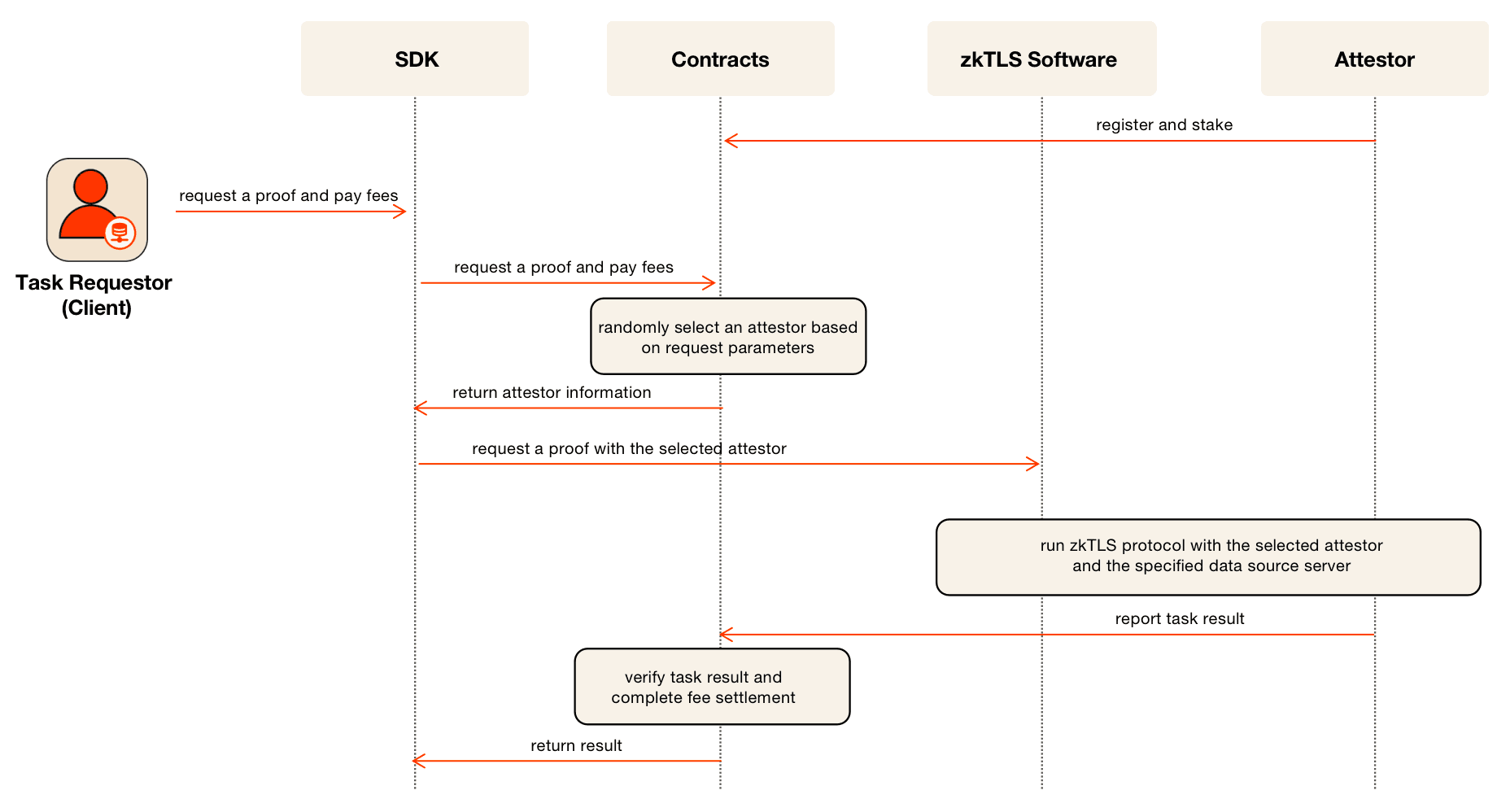
A typical task workflow proceeds as follows:
- A client initiates a task via an app built with the Primus SDK.
- The task is submitted to the network and routed for execution.
- A node operator executes the task according to protocol requirements.
- The network returns task outputs and verification artifacts.
- The client/application consumes the result for downstream use (on-chain or off-chain).
Depending on the workload profile, task execution may follow different protocol paths (e.g., MPC-oriented or proxy-oriented verification flows) while sharing a common network coordination model.
Related docs
- For staking, incentives, and slashing design, see Network Security.
- For governance structure and decision flow, see Network Governance Framework.
- For token allocation and vesting, see Tokenomics.